01The short answer
El Pescadero is the farm town of the corridor, a few thousand residents[1] sitting 8 mi / 13 km south of Todos Santos and 4 mi / 6 km north of Cerritos[2], on some of the best-watered ground in southern Baja. It has the corridor's most affordable entries on one side of the highway and some of its best new builds on the other, and almost nobody who writes about it has noticed they're different places.
I send two completely different kinds of buyers to Pescadero, and the highway is the line between them.
02The east/west split
East of Highway 19 is the original town. The church, the school, the tiendas, families who've farmed here for generations, dirt streets that flood in September and dust in May. The rhythm is agricultural and the prices are the corridor's gentlest: this is where fixer adobes, small lots, and long-game land plays still exist. It is also, and I say this as the thing I like most about it, an actual Mexican town rather than an amenity zone. If you move east of 19, you're moving to Mexico, not to an expat colony that happens to be in Mexico.
West of Highway 19 runs from the fields to the beach: newer construction, boutique hotels, yoga studios, the restaurant row, and homes built for the breeze and the surf. This is where most of the corridor's mid-to-upper new inventory has gone in the last decade, and where ocean proximity does to prices exactly what you'd expect. The west side is also windier and cooler in summer, a microclimate difference real enough to factor into a purchase; the mechanics are in our weather report.
The same budget buys a finished home east of 19 or a lot and a construction project west of it. Neither is wrong. But they're different bets on different futures, and a listing that just says "Pescadero" is hiding the single most important fact about itself.
03The farm economy is the town
Pescadero sits where the Sierra de la Laguna's runoff meets the coastal plain, which is why this stretch has grown food for centuries while the rest of the peninsula grows cactus[3]. The fields turn out basil and herbs, chiles, strawberries, and row vegetables, and a meaningful share of it ships out of the region[4].
Living here, the farm economy is a daily texture rather than a fact: produce stands at field gates, the smell of basil on the evening air in the right season, tractors on the highway shoulder at dawn, and restaurant menus that name the field the greens came from because the field is 400 meters away. Our resident's restaurant guide follows that food culture from the fields to the local counters.
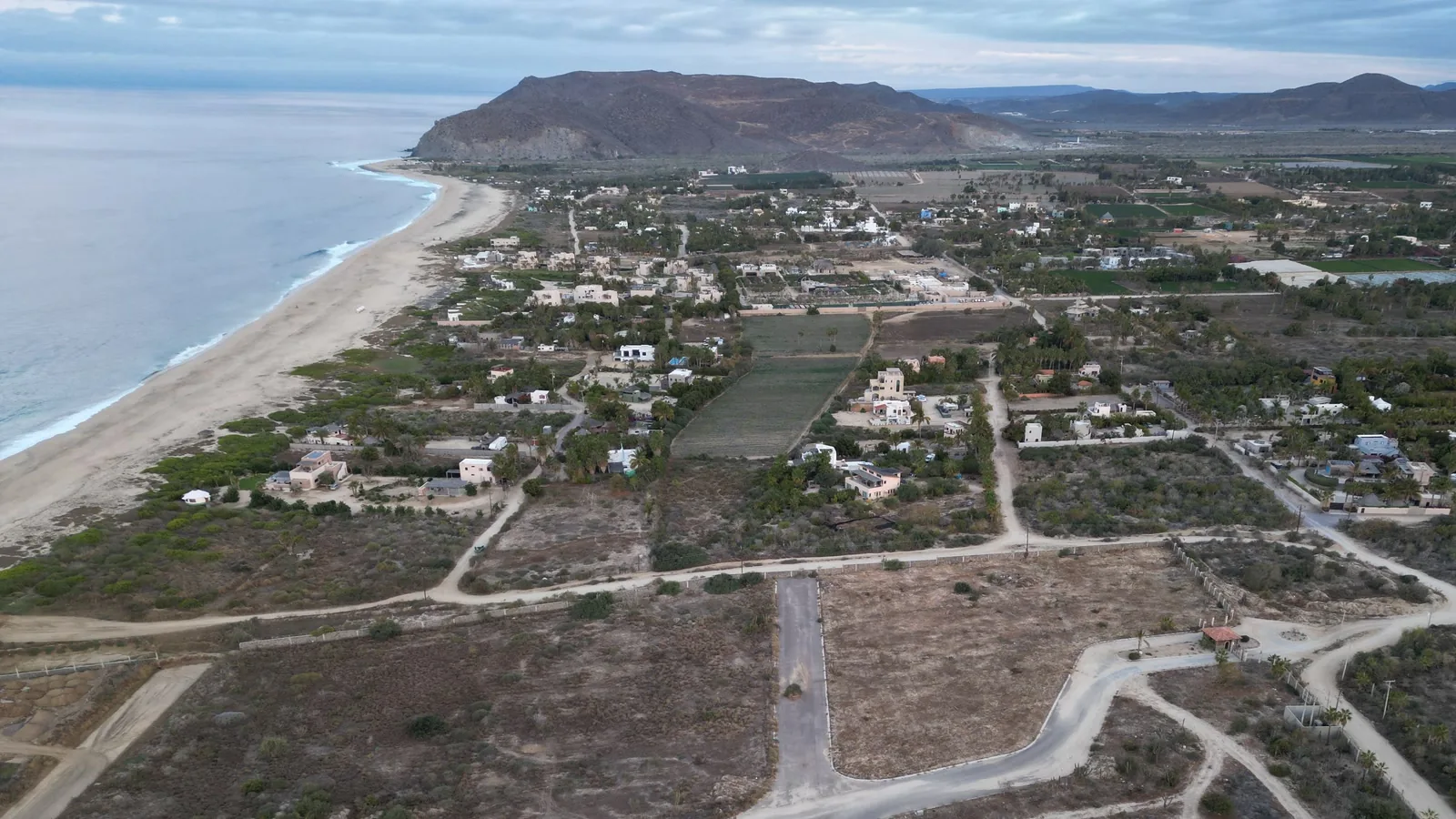
04San Pedrito & the coast
Pescadero's beach identity is anchored by San Pedrito at the north end: a rocky point over cobblestone that works on winter northwest swell and belongs to surfers who know what they're doing[5]. It is not a swimming beach and not a learning wave; it's the one the good surfers in the corridor quietly consider theirs.
For swimming and learning, Cerritos is 5 minutes south. That’s the arrangement: Pescadero gets the quiet and the farmland, Cerritos gets the swimmable water, and they're close enough to share. The full coast, break by break, is in the beaches & surf report.
05Water & land, honestly
The water that makes Pescadero farmable also makes it the corridor's most interesting land market, and the diligence here is specific.
Wells and rights. Much of the area runs on wells, and agricultural land can carry water arrangements that don't transfer the way a foreign buyer assumes. Verify the concession, not the seller's summary.
Ejido land. A meaningful share of the land around Pescadero traces back to ejido (communal agrarian) grants, and buying improperly regularized ejido land is the single most expensive mistake available to a foreign buyer in this corridor. If the price looks unbelievable, this is usually why. The buying-process guide covers the mechanics; the short version is: notario, title study, patience.
Arroyos. The same drainages that feed the fields run hard in storm season. Walk any lot with September in mind, not just February. Our infrastructure report covers the tinaco-and-solar reality of building out here.
06Who Pescadero fits, and who it doesn't
It fits people who want land, quiet, and food growing within earshot; buyers priced out of Todos Santos centro who still want the corridor; and anyone whose ideal evening is a farm dinner rather than a gallery opening. East of 19 fits people who genuinely want to live in a Mexican town. West of 19 fits people who want new construction with the surf 5 minutes away.
It doesn't fit people who need walkable errands (that's Todos Santos), a swimmable beach out front (that's Cerritos), or anyone unwilling to do real land diligence. Pescadero rewards homework and punishes shortcuts more than anywhere else in the corridor.
Pescadero is where we spend the most diligence hours per deal, and where they pay off best. Browse current El Pescadero listings; if a parcel catches your eye, the ejido question is conversation one.
07Quick answers
Is there anywhere to eat? A short, good list that keeps growing: the restaurant row west of the highway, the farm-dinner spots, and the roadside stands. Todos Santos handles the fancy nights, 10 minutes north. Start with the restaurant guide; for a current receipt-backed example, read the Sushi Bar Kata field note.
Errands? Tiendas and basics in town; real shopping in Todos Santos; Costco runs to Cabo or La Paz, about an hour either way[2].
Internet and power? CFE reaches town and the main west-side corridors; the outer parcels run solar and Starlink. Full picture in the infrastructure report.
Is it safe? Same answer as the corridor generally, with the same caveats: see the safety report. Out here, the most dangerous thing is an unlit cow on Highway 19 at night, and I mean that literally.
Pescadero or Cerritos? Land and quiet versus beach and rental engine. If you're torn, rent on each side of the highway for a month before buying anything. Cheap education.
08Sources
[1] Wikipedia, El Pescadero BCS (INEGI census figures) · [2] Google Maps, Highway 19 distances · [3] InternationalParks.org, Sierra La Laguna watershed · [4] TodosSantos.cc, Pescadero overview · [5] Surfline, San Pedrito. Population and distance figures are approximations from the cited sources; verify anything you'd bet a purchase on.
Curtis brokers real estate through Selling Sur in the Todos Santos–Pescadero–Cerritos corridor, and lives in Pescadero, at San Pedrito Beach. He doesn't sell a fantasy; he sells information so you can make a smart call, including the call that Baja isn't right for you.
El Pescadero sold and current properties.
Browse the existing Selling Sur sold archive and current listings for this area. This is brokerage inventory, not a corridor-wide market report.